Ghraam
GHRAAM Pure A2 Cow Ghee Trio Pack : Gir, Sahiwal & Rathi (500ml x 3)
Share
Price includes NABL-accredited lab testing on every batch, traditional Bilona preparation, and secure leak-proof packaging.
Couldn't load pickup availability
Quick answer: The Pure A2 Cow Ghee Trio combines GHRAAM's Gir, Sahiwal, and Rathi A2 cow ghee – 500ml each – made using the traditional Bilona method and lab-tested by an NABL-accredited laboratory. You save 5% compared to buying each jar separately.
Key takeaway: If you're new to A2 ghee or unsure which breed suits your taste, the Trio lets you compare all three without committing to a full jar of just one.
Who this guide is for: Anyone new to A2 cow ghee wanting to compare Gir, Sahiwal, and Rathi before settling on a favourite, or buying a gift for someone who hasn't tried GHRAAM before.
Gir, Sahiwal, and Rathi are among India's most celebrated desi cow breeds, each producing A2 milk with its own distinct character. The Pure Cow Trio lets you experience all three in one collection – A2 Gir Cow Ghee with its deep golden colour and rich aroma, A2 Sahiwal Cow Ghee with its smooth, buttery finish, and A2 Rathi Cow Ghee with its light, nutty flavour.
Gir, Sahiwal, and Rathi are all officially registered indigenous cattle breeds recognised by the National Bureau of Animal Genetic Resources (NBAGR), the Indian government body that documents native livestock.
All three are made the traditional Bilona way: milk is set into curd, hand-churned into butter, and slow-cooked over low heat – no shortcuts and no machine-separated cream. Every batch is lab-tested for purity, so what you get is exactly what the label promises.
For example, many customers who order the Trio tell us they didn't expect to notice a difference between the three - but end up picking a favourite after tasting each one plain, before deciding which to reorder.
What's included:
Save 5% compared to buying all three individually.

Made the Bilona Way
Fresh milk is first set into curd overnight, then hand-churned in a traditional bilona to separate makkhan (butter) — not machine-separated cream, which is how most commercial ghee is made.
The butter is slow-cooked over low heat in small batches, a process that takes 36-48 hours from milk to jar. No shortcuts, no industrial shortcuts speeding it up.
This is what gives GHRAAM ghee its distinct, slightly tangy depth of flavour that mass-produced ghee doesn't have.
Why does the ghee look grainy or crystallised?
That's normal – and actually a good sign. Traditionally made bilona ghee often develops a coarse, granular texture as it cools, because it hasn't been industrially homogenised or blended with additives to force a uniform look. Texture also varies naturally with temperature and season. If your jar looks smooth in summer and grainy in winter, nothing has gone wrong.
For the full explanation – including the science behind it and how to tell texture apart from actual spoilage – see our complete guide on grainy ghee texture.
Every Batch, Lab-Verified
Purity isn't a claim we make — it's something we test for, every single batch.
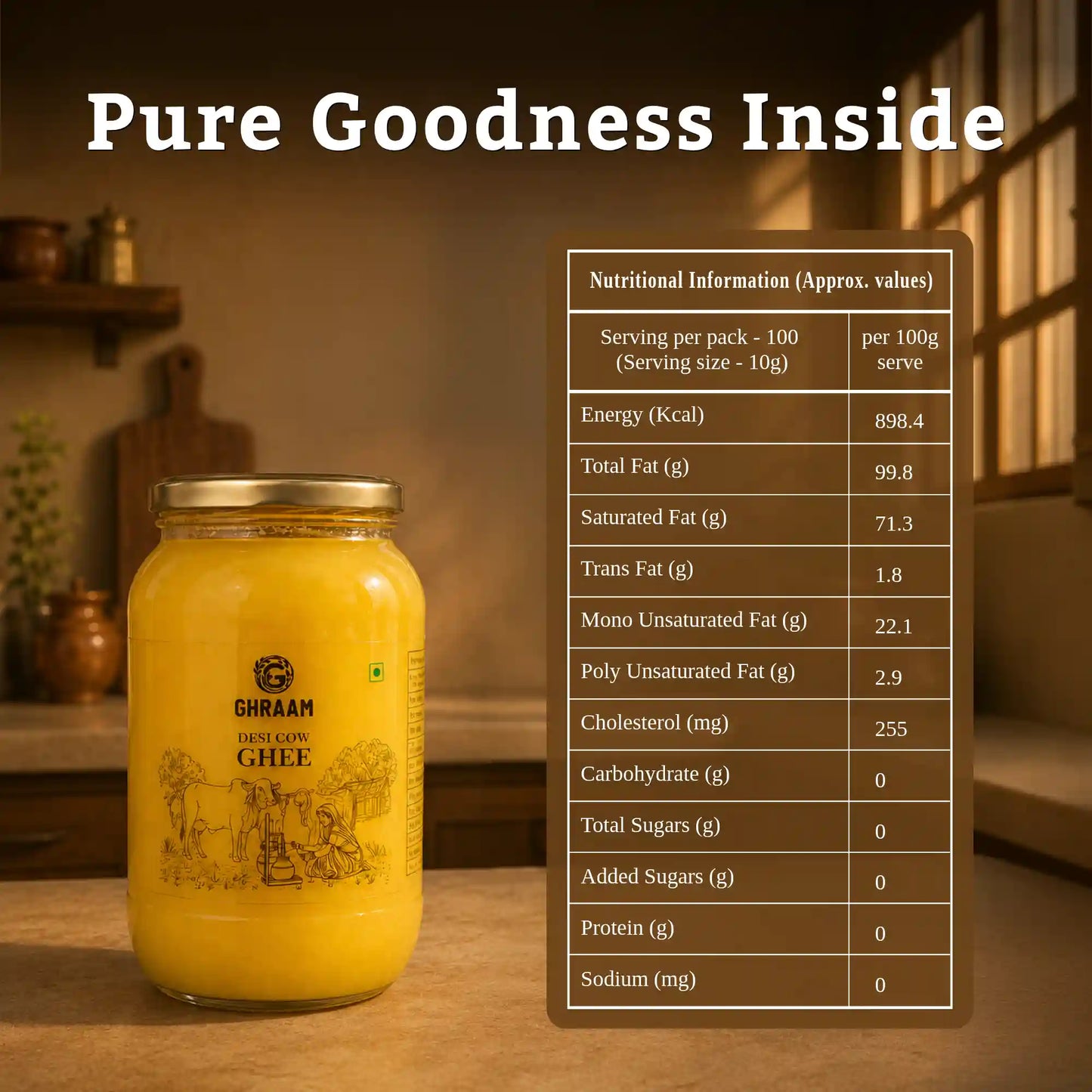
Each variety is independently tested by ARBRO Pharmaceuticals, an NABL-accredited lab, checking for the Baudouin test (rules out vanaspati), Reichert-Meissl value (confirms authentic milk fat), and overall milk fat content — typically 99.9%+ against the 99.5% minimum requirement.
No added starch, no mineral oil, no shortcuts. We publish the actual reports, not just a "lab tested" badge.
Blogs
View all-
Ghee in Modak: Why It Matters for Ganesh Chaturthi
Ghee shows up in both the steamed and fried versions of modak, Ganesha's favourite sweet. Here's why, with real recipes for each.
Ghee in Modak: Why It Matters for Ganesh Chaturthi
Ghee shows up in both the steamed and fried versions of modak, Ganesha's favourite sweet. Here's why, with real recipes for each.
-
Panchamrit Recipe & More for Janmashtami: Why G...
Panchamrit, makhan mishri, mathura peda: ghee shows up in nearly every Janmashtami tradition, not by accident. Here's why, with real recipes for each.
Panchamrit Recipe & More for Janmashtami: Why G...
Panchamrit, makhan mishri, mathura peda: ghee shows up in nearly every Janmashtami tradition, not by accident. Here's why, with real recipes for each.
-
Raksha Bandhan Sweets: The Role Ghee Actually P...
Raksha Bandhan sweets almost always start with ghee, not as decoration but as the actual ingredient doing the work. Here's why, and a real recipe.
Raksha Bandhan Sweets: The Role Ghee Actually P...
Raksha Bandhan sweets almost always start with ghee, not as decoration but as the actual ingredient doing the work. Here's why, and a real recipe.
Frequently Asked Questions
Key takeaway: All GHRAAM ghee varieties share the same Bilona process and NABL-accredited purity standard — the choice between Gir, Sahiwal, Rathi, and Buffalo comes down to taste and use case, not quality.
Which type of ghee should I choose?
GHRAAM offers Gir, Sahiwal, Rathi, and Buffalo Ghee. All four are made using the same Bilona process and purity standard, so any is a good everyday choice — the difference is mainly aroma and texture. If you cook mostly festive dishes or sweets, Buffalo Ghee's richness suits that better; for daily cooking, rotis, and dal, any of the three cow ghee varieties work well.
What is the actual difference between Gir, Sahiwal, Rathi and Buffalo Ghee?
Gir has a rich aroma and golden colour, Sahiwal has a smooth texture and authentic flavour, and Rathi has a rich aroma with smooth texture — all three cow varieties are lighter and easier to digest. Buffalo Ghee has a noticeably higher fat content and richer, creamier texture, making it better suited to festive cooking and sweets.
Are all GHRAAM ghee products made using the Bilona method?
Yes. Every variety of GHRAAM Ghee is prepared using the traditional Bilona method.
Are all your products lab tested, and can I see the reports?
Yes. Every batch is tested by an NABL-accredited laboratory, and the reports are available on our Lab Reports page.
Do your ghee products contain preservatives?
No. None of our ghee products contain preservatives, artificial colours, or artificial flavours.
Can I order ghee anywhere in India?
Yes. We deliver GHRAAM products across India free.
What's the shelf life of GHRAAM ghee?
Ghee is naturally shelf-stable and doesn't require refrigeration. Stored in a cool, dry place away from direct sunlight, GHRAAM ghee stays good for up to 12 months from the date of packing. Always use a clean, dry spoon to prevent contamination.
Is Cash on Delivery (COD) available?
Yes, COD is available across India on all GHRAAM orders, along with UPI and card payments at checkout.