How to Identify Pure Honey: Labels, Tests & Lab Reports
Learn how to identify pure honey and check honey purity through label and traceability checks, the limits of home tests, and a real honey laboratory report.
Read story Skip to content

✦ GHRAAM · OUR PRODUCTS Shop GHRAAM’s traditional food range. Explore GHRAAM...
Ghraam
Price includes NABL-accredited lab testing on every batch, traditional Bilona preparation, and secure leak-proof packaging.
Couldn't load pickup availability

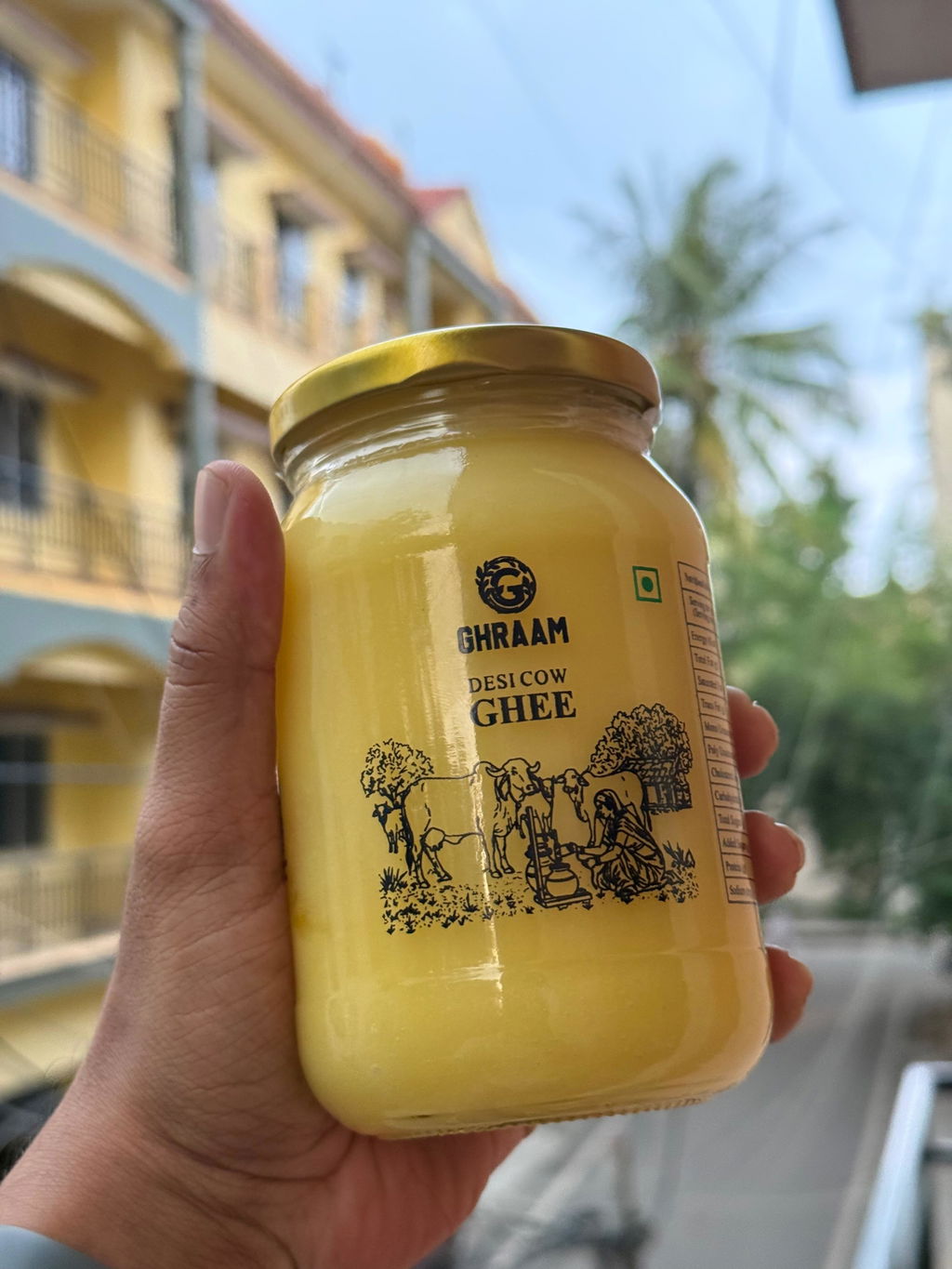
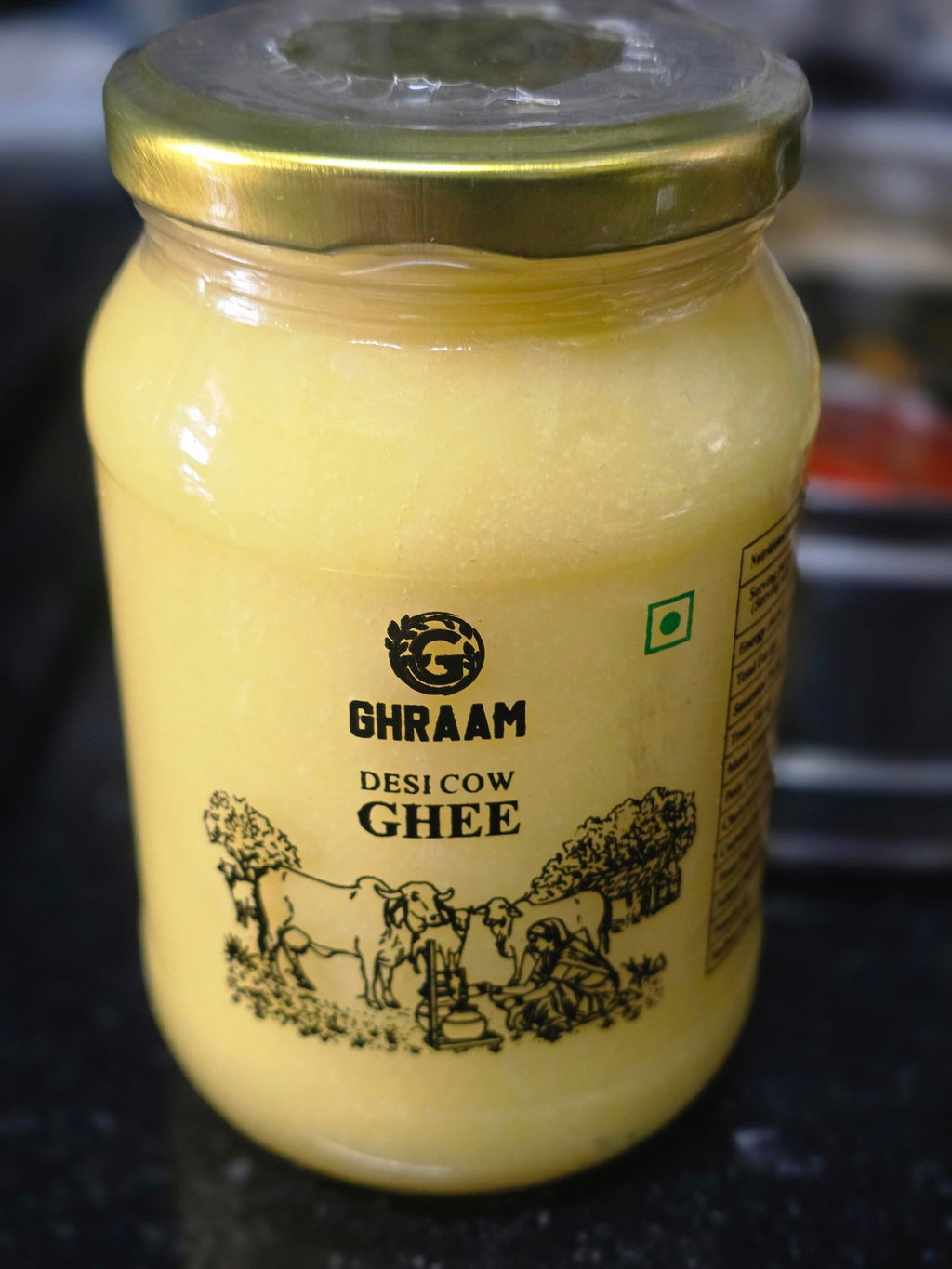
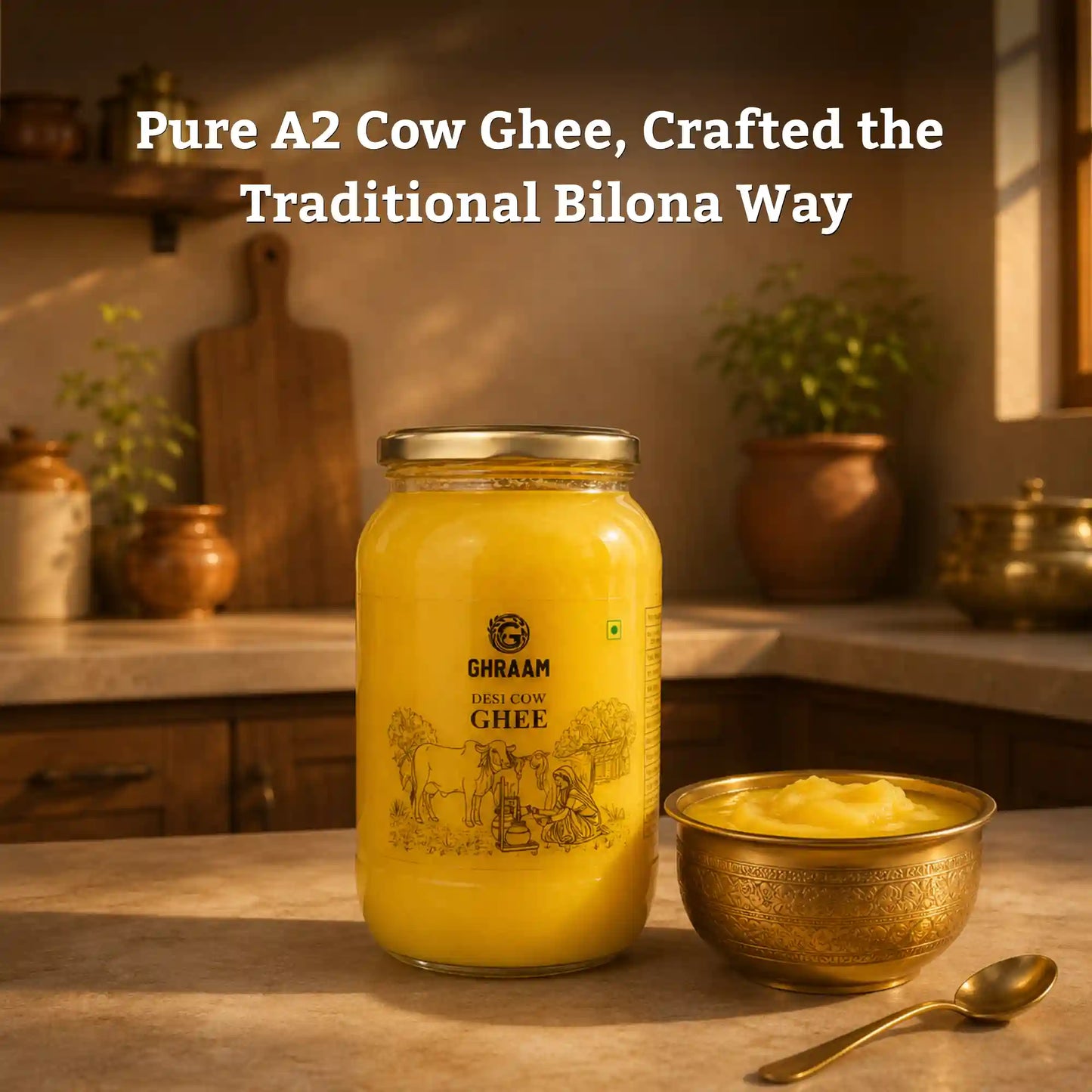
GHRAAM A2 Gir Cow Ghee is made from desi Gir cow milk using the traditional Bilona method. The milk is cultured into curd, hand-churned to obtain makkhan, and then slowly prepared into ghee in small batches. The result is a ghee with a rich aroma, golden colour and a naturally grainy texture.
If you are looking to buy A2 Gir Cow Ghee online, this page brings together the product details, available pack sizes, preparation information and batch-specific laboratory results so you can make an informed choice.
Gir cows are a recognised native Indian cattle breed. GHRAAM follows the traditional Bilona process to prepare this Gir cow ghee. To understand the breed, the Bilona method and traditional uses in more detail, read our A2 Gir Cow Ghee guide.
Looking for the price of Gir cow ghee? GHRAAM A2 Gir Cow Ghee is available in two pack sizes: 500 ml at ₹1,049 and 1 litre at ₹1,999. The 1 litre jar offers a lower price per millilitre and may suit regular use, while the 500 ml jar is a practical option if you are trying this variety for the first time or keeping it alongside another ghee. Check the live variant selection above for the current price and availability. If you are comparing the Gir cow ghee price, consider the pack size that best suits your household.
You can also explore the Pure A2 Cow Ghee Trio to try Gir, Sahiwal and Rathi, or the Twin Gold combo for Gir and Sahiwal.
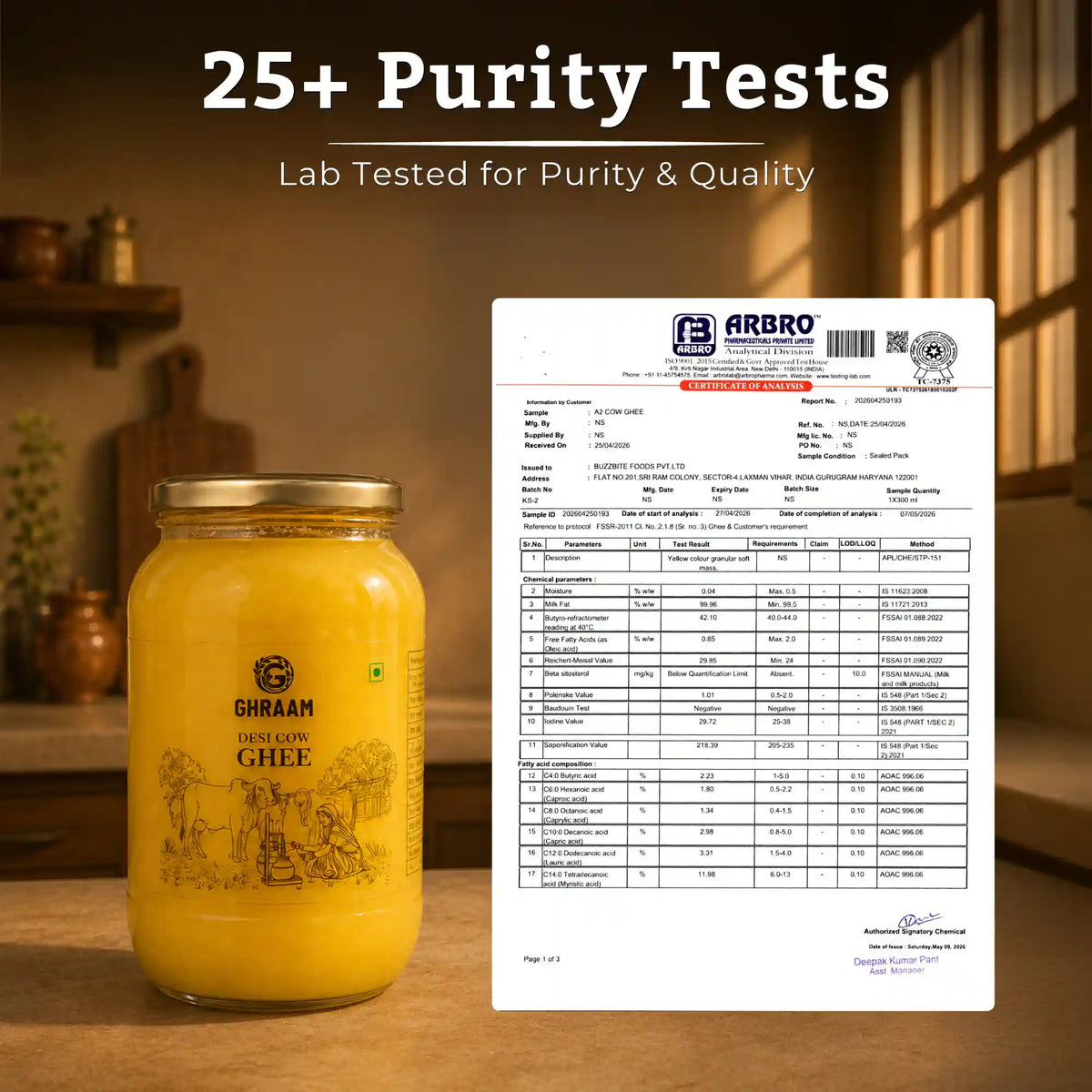
GHRAAM publishes laboratory results for selected batches tested by an NABL-accredited laboratory. The May 2026 Certificate of Analysis from ARBRO Pharmaceuticals for Batch KS-2, Report No. 202604250193, reported 99.96% milk fat for the tested A2 Gir Cow Ghee sample, against a minimum requirement of 99.5%. The report also recorded a Reichert-Meissl value of 29.85 and a negative Baudouin test result. The report lists findings for added starch and mineral oil as well; consult the linked PDF for the exact findings for this sample.
A negative Baudouin result alone does not rule out every possible adulterant. The results below apply to the specific sample and batch tested; they should not be interpreted as a guarantee about every batch or as a test for substances not included in the report.
| Batch No. | KS-2 |
|---|---|
| Report No. | 202604250193 |
| Report issue date | 09 May 2026 |
| Laboratory | ARBRO Pharmaceuticals (NABL-accredited) |
| Parameter | Result | Test Method |
|---|---|---|
| Milk fat | 99.96% | IS 11721:2013 |
| Moisture | 0.04% | IS 11623:2008 |
| Reichert-Meissl value | 29.85 | FSSAI 01.090:2022 |
| Baudouin Test | Negative | IS 3508:1966 |
View current batch laboratory report (PDF) →
Results shown above apply to the tested sample and batch only.
Bilona ghee can naturally have a grainy or granular texture. Its texture may vary with temperature and storage conditions. Texture or colour alone should not be used to determine purity; for quality verification, refer to the relevant laboratory testing and batch documentation.
GHRAAM A2 Gir Cow Ghee can be used for everyday cooking, traditional sweets and serving with foods such as warm rotis. Keep the jar in a cool, dry place away from direct sunlight. Refrigeration is generally not necessary. Always use a clean, dry spoon to help keep the ghee free from moisture and contamination, and follow the shelf-life and packing information printed on your jar.


GHRAAM • Traditional Bilona
GHRAAM A2 Gir Cow Ghee is prepared from desi Gir cow milk using the traditional Bilona method. In this method, milk is cultured into curd, the curd is churned to obtain makkhan, and the butter is heated to make ghee.
Gir identifies the cow breed associated with the milk source; Bilona describes the preparation method. They refer to different parts of the product story.
Explore our A2 Gir Cow Ghee guide for more context on the breed and traditional preparation.
“A familiar Indian kitchen staple, shaped by traditional preparation.”
Milk → Curd → Makkhan → Ghee
Product transparency
GHRAAM publishes laboratory documentation for selected batches. The linked May 2026 report records results for the tested sample identified below.
Report no. 202604250193 • Issued 09 May 2026 • ARBRO Pharmaceuticals (NABL-accredited). Results apply to the specific sample and batch tested; they should not be interpreted as a guarantee for every batch or as a test for every possible adulterant.

THE ART OF TRADITION
At GHRAAM, we honour the traditional Bilona method of making ghee. The process follows three simple stages.
Milk is cultured into curd, following a traditional first step.
The curd is churned to obtain makkhan (butter).
The butter is slowly heated to prepare ghee.
A time-honoured method, thoughtfully presented for today’s kitchen.
Explore the Bilona methodA natural texture can change with temperature and season.
Traditionally made Bilona ghee may develop a coarse, granular texture as it cools. Texture can vary naturally with temperature and season, so a smooth summer jar and a grainier winter jar can look different. Texture alone, however, is not a reliable test of purity or freshness.
Read the texture guideNOTES ON FOOD & TRADITION
Thoughtful reads for curious kitchens.
Learn how to identify pure honey and check honey purity through label and traceability checks, the limits of home tests, and a real honey laboratory report.
Read storyLearn how to check ghee purity with simple home observations, understand their limits, and read a real batch-specific lab report before you buy.
Read story"A2 ghee" shows up everywhere in wellness conversations, often with more marketing than substance behind it. Here's what the term actually means, in plain terms.
Read storyReally impressed with the quality of the ghee! Pure, rich, aromatic, and genuinely feels homemade. The organic taste and texture are excellent. Got it delivered all the way from Delhi to Bangalore, and the quality was absolutely worth it. Highly recommended!
This ghee is of exceptional quality, reminiscent of homemade. The packaging is excellent, ensuring no spillage or loss.
Great taste and even better pricing.
Excellent quality and authentic taste! The ghee is pure, rich, aromatic, and feels genuinely homemade. Great product quality and smooth ordering experience. Highly recommended for anyone looking for premium organic desi ghee.
Ordered gir cow ghee and ghee quality and packing is superb.
GHRAAM A2 Gir Cow Ghee is made from milk sourced from Gir cows and prepared using the traditional Bilona method. The product is presented as A2 Gir Cow Ghee based on the milk sourcing and product specification.
The ghee is prepared using the traditional Bilona process. This refers to the traditional preparation method used to make ghee from cultured curd rather than being a statement about the cow breed itself.
GHRAAM publishes batch-wise laboratory reports for its ghee products. You can check the published Gir Cow Ghee report on the GHRAAM Lab Reports page for the reported test results of the available batch.
Ghee can naturally become grainy, semi-solid or fully solid as temperature changes. Texture alone is not a reliable purity test.
Store the jar in a cool, dry place away from direct sunlight and moisture. Always use a clean, dry spoon to keep the ghee in good condition.
No. A2 refers to a beta-casein type associated with the source milk, while Bilona describes the traditional method used to prepare the ghee. They describe different aspects of the product.