Real Lab Reports, Not Just Purity Claims

Reports last updated: June 2026

What are lab reports, in plain terms? A lab report is an independent test certificate from an accredited laboratory confirming what's actually in a food product — not just a brand's claim about it.

Quick answer: At Ghraam, every batch is tested by ARBRO Pharmaceuticals, a government-approved, NABL-accredited testing laboratory (Certificate No. TC-7375), following FSSAI's official FSSR-2011 ghee testing standards.— covering purity markers like the Baudouin test, milk fat content, and moisture levels for each variant.

Every single batch we produce is tested before it ships — not a one-time certification for the product line, but a fresh report for every batch.

Key takeaway: Real lab reports show specific test values, not just a "pure" badge — that's the difference between a verifiable claim and marketing.

Who this page is for: Anyone deciding whether to trust GHRAAM's purity claims before buying, or wanting to compare our actual test results against any other brand's claims.

Test GHRAAM's Result Legal Minimum (FSSAI)
Milk Fat (Gir) 99.96% Min. 99.5%
Reichert-Meissl Value (Gir) 29.85 Min. 24
Baudouin Test (all variants) Negative Must be Negative

Full batch-wise comparison for all four variants available in each downloadable report below.

For example, when we compared our own reports against publicly available ones from other brands, most competitors show a certification badge with no underlying data — GHRAAM's reports list the actual Reichert-Meissl value, moisture percentage, and specific test method for each parameter.

How to Read Your Lab Report

  • Baudouin Test — checks for vanaspati (hydrogenated vegetable fat) adulteration. Should always read "Negative."
  • Milk Fat % — the actual dairy fat content. FSSAI requires a minimum of 99.5% for pure ghee.
  • Reichert-Meissl (RM) Value — confirms the fat is genuine butterfat, not a substitute. Must be at least 24.
  • Moisture — should stay below 0.5%; higher levels can indicate improper processing.
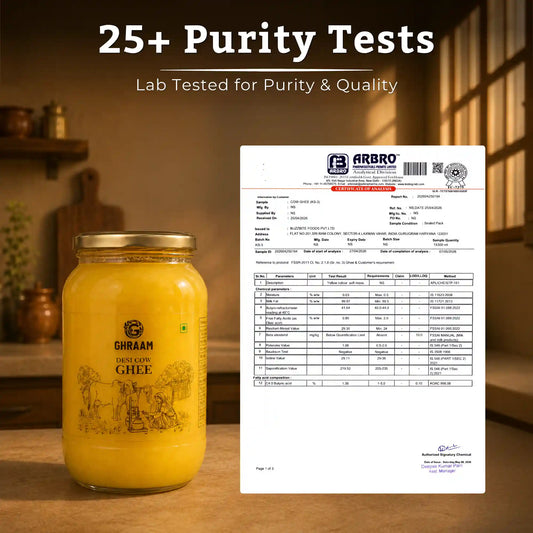
  • A jar of GHAAM Gir Cow Ghee with a purity test lab certificate overlay

    A2 Gir Cow Ghee

    Batch KS-2 · Milk Fat 99.96% · Baudouin Test: Negative

    View Lab Report 
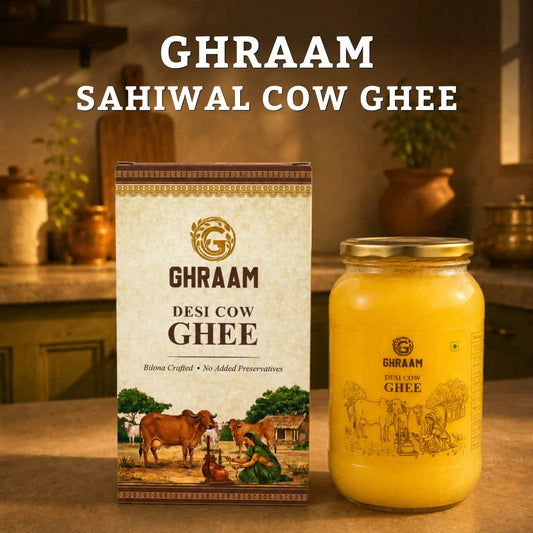
  • A2 Cow Ghee jar with lab report

    A2 Sahiwal Cow Ghee

    Batch 1 · Milk Fat 99.95% · Baudouin Test: Negative

    View Lab Report 
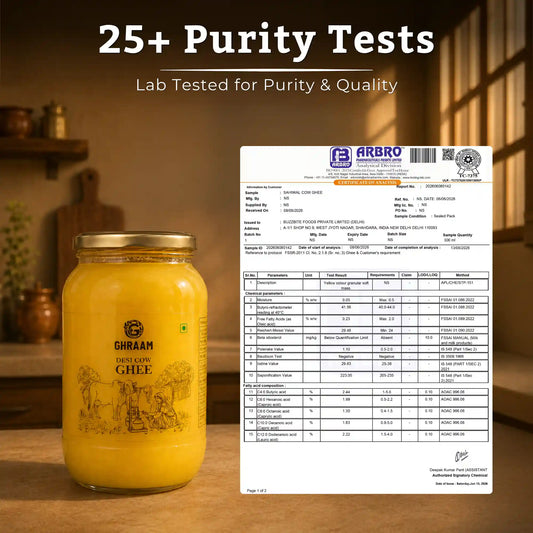
  • A jar of GHAAM desi ghee with a purity test lab report

    A2 Rathi Cow Ghee

    Batch KS-3 · Milk Fat 99.97% · Baudouin Test: Negative

    View Lab Report 
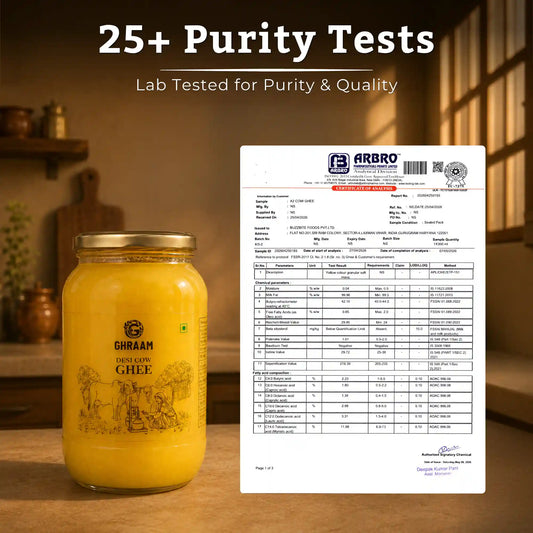
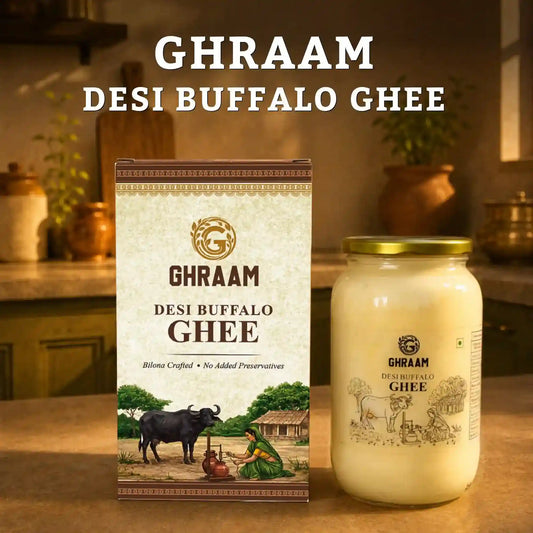
  • Ghraam Pure Desi Buffalo Ghee with a detailed purity test lab report sheet

    A2 Buffalo Ghee

    Batch KS-1 · Milk Fat 99.82% · Baudouin Test: Negative

    View Lab Report 

Frequently Asked Questions

Why does GHRAAM provide lab reports?

Purity should be proven, not just promised. Every batch is tested by ARBRO Pharmaceuticals (Certificate No. TC-7375), an NABL-accredited lab, so you see actual test values — like 99.96% milk fat — not just a 'pure' badge.

Are all GHRAAM products lab tested?

Yes. Every batch across all four variants (Gir, Sahiwal, Rathi, Buffalo) undergoes lab testing before it ships — with results as high as 99.97% milk fat (Rathi), well above the FSSAI minimum of 99.5%.

Which laboratory tests are performed?

We test for the Baudouin test (checks for vanaspati adulteration), milk fat content (min. 99.5% required by FSSAI, GHRAAM averages 99.9%+), and Reichert-Meissl value (min. 24 required) — all per FSSAI's FSSR-2011 standard.

Are the lab reports genuine?

Yes. All reports are issued directly by ARBRO Pharmaceuticals (Certificate No. TC-7375), an independent NABL-accredited lab — not self-certified. You can view or download the actual batch-wise PDFs on this page.

How can I view the lab reports?

Batch-wise PDF reports for all four variants (Gir, Sahiwal, Rathi, Buffalo) are downloadable directly on this page above, or you can ask to see them in person at our Delhi showroom.

Why is lab testing important for ghee?

Ghee is one of the most commonly adulterated dairy products in India, often mixed with vanaspati or cheaper fats. Lab tests like the Baudouin test and Reichert-Meissl value are the only reliable way to confirm what's actually inside — not just what the label claims

Does every batch have a different lab report?

Yes — for example, our current reports are Batch KS-1 (Buffalo), KS-2 (Gir), and KS-3 (Rathi), each with its own test date and results, since ghee quality can vary slightly batch to batch even with the same process.

How does GHRAAM ensure product quality?

We combine the traditional Bilona method (36-48 hours per batch), careful sourcing from single desi breeds, and independent NABL lab testing on every single batch — not just periodic spot-checks.

What does a negative Baudouin test actually mean?

It means no vanaspati (hydrogenated vegetable fat) was detected — one of the most common ways ghee gets adulterated. A negative result confirms the product is genuine ghee, not a blend.

Why does the Reichert-Meissl value matter?

It confirms the fat tested is authentic milk fat rather than a substitute — not vegetable oil or a cheaper fat blended in. FSSAI requires a minimum of 24; GHRAAM's ghee tests between 29.30 (Rathi) and 29.85 (Gir), well above this threshold.